Welcome  Posts about photography, contract bridge, astrophotography, astronomy, Java development, internet systems. |
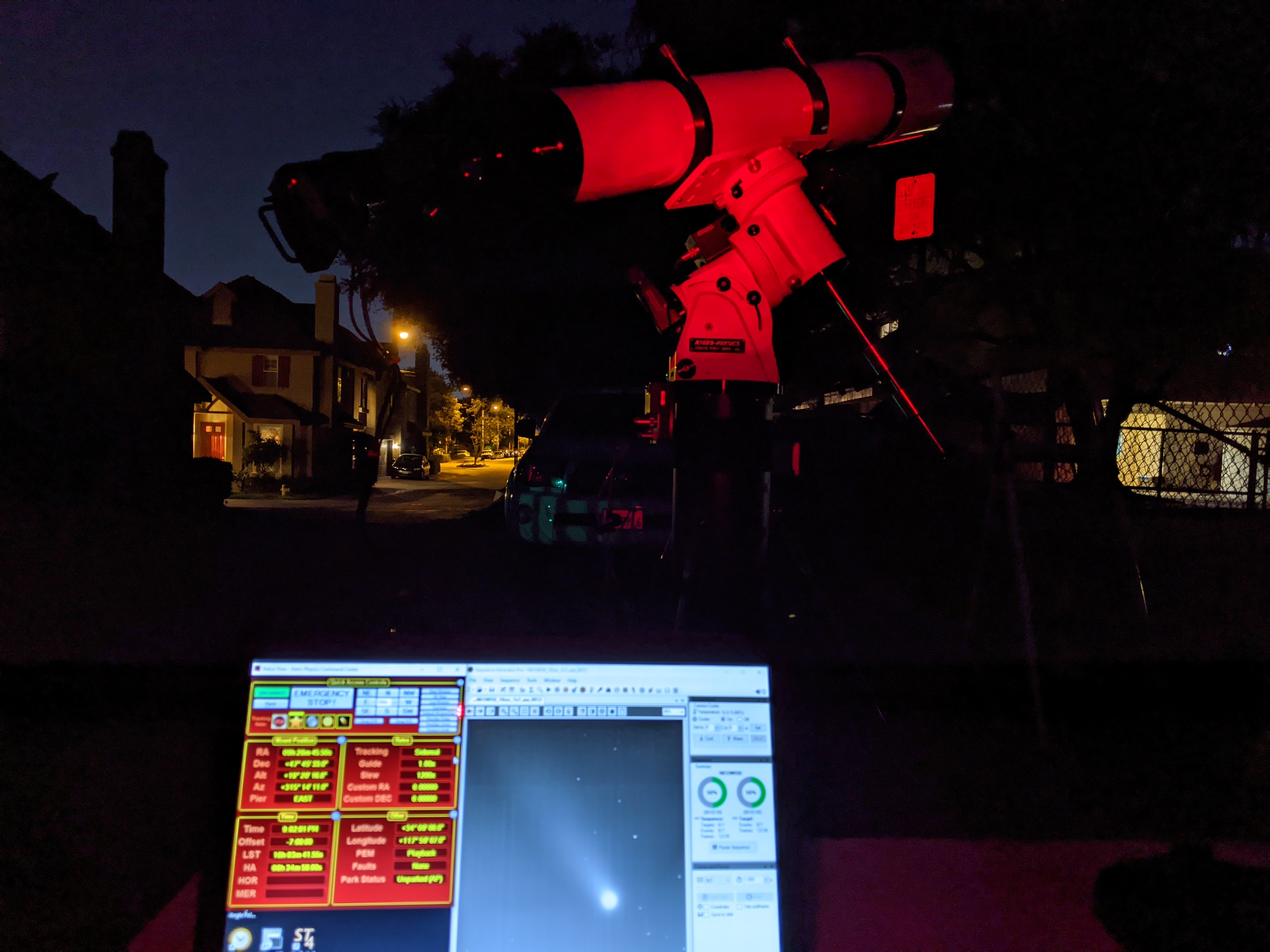
I set up the AP180 last night and was able to capture comet NEOWISE as it passed through Ursa Major.
This video is fifty frames covering about 27 minutes, from 9:11 p.m. to 9:38 p.m. on July 19, 2020.
Each frame is a 10-second exposure.
 Here’s a view of my computer screen and the AP180 as I captured the comet frames.
It’s been many years since I first celebrated being able to autoguide while exposing astrophotos on my CCD camera. (Finally autoguiding from 2009.)
Now with new techniques and software available, I might be able to abandon autoguiding.
The current software and hardware stack for astrophotography is so vastly different and better than what I had to work with […]
We had several great clear nights in Monrovia. I had a night where everything clicked. If I hadn’t napped a bit, I might have gotten two or three more Messier objects.
I think now I know the most difficult part of urban astrophotography — at least with the camera I use: Finding suitable guide stars!
I can position […]
Last night (Saturday, May 23, 2020) was a beautiful dark clear night in Monrovia. Tonight is forecast to be even better and warmer. I can’t resist! When will I sleep?
By the end of evening twilight, I was aligned, focused, calibrated, synced, and ready to image.
I’ve been cherry picking Messier objects that were near their highest altitude […]
Evening twilight with the AP180 at Sawpit Wash, 50 yards from our front door.
The previous post mentions how I started trying out photographing Messier objects from my home in Monrovia, using my Astro-Physics Traveler 105mm f/6 refractor. The results were encouraging enough that I had to bring out the giant AP180EDT and see how that […]
In the wee hours of May 15, hunting down Comet C/2020 F8 SWAN
Normally I wouldn’t even have considered trying this project. I’m known for hauling my telescopes to a dark sky site in the desert to do deep sky astronomy — visual or photographic.
But here we all are, staying home for the duration.
I have a […]
 Observing report, February 23, 2020
This would be my first night observing from a powered telescope pad at GMARS, Riverside Astronomical Society’s Goat Mountain Astronomical Research Station, in Landers, CA. It was a beautifully clear but cold February Sunday evening. It was also the first real observing night for a new mount, plus a new and unfamiliar […]
This is the first new blog post from me in four years, and long overdue.
Why blog now?
I enjoy writing and reporting about stuff in my life: astronomy, travel, bridge, wine, photography, network systems.
And Facebook is Dead To Me.
Since my last post, Jane and I have both retired, I opened and closed a weekly bridge club, we […]
Last year, I had some really bad luck with astrophotography.
I replaced my old laptop (Dell, Windows XP) and installed a new suite of tools to replace the somewhat ancient and unsupported camera software. At one point during my first “shakeout” evening (October 2014), the new software started spinning my telescope around the declination axis. It made […]
Here are five tables worth of hands ready for my next class. Each table gets boards one through four, in a distinctive board color.
Last month I took a leap and purchased a bridge hand dealing machine. The PlayBridgeDealer4 is very popular with bridge clubs and tournament managers for preparing pre-dealt hands and duplicating them across […]
|
|